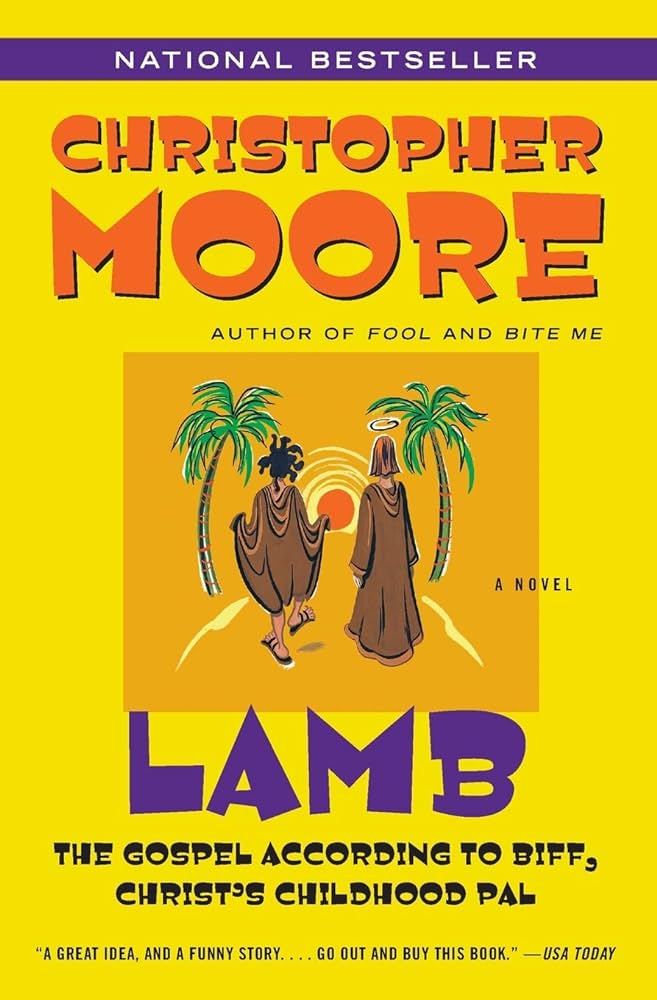
lamb | christopher moore
I came for the gloriously stupid humor, which flowed in abundance, and I stayed for the moments of equally hilarious profundity. Besides winning candy during Bible trivia night, my bygone years of Christianity have never served me so well as in the laugh-crying that came from getting all these jokes. Truly, this was the Gospel that I’ve been missing, and I am well pleased to have this new perspective on Josh.
notes:
From the Author’s blessing:
If you have come to these pages for laughter, may you find it.
If you are here to be offended, may your ire rise and your blood boil.
[…]
May you find that which you seek, in these pages or outside them.
May you find perfection, and know it by name.
Stephan coughed, clearly an affectation, since angels didn’t breathe.
“Go get the good news, Raziel. Bring me back some chocolate.”
“Chocolate?”
“It’s a dirt-dweller snack. You’ll like it. Satan invented it.”
“Devil’s food?”
“You can only eat so much white cake, my friend.”
“You lie, it takes forty years to get to Egypt.”
“Not anymore, it’s closer now.”
“It says in the Torah. My abba read it to me. ‘The Israelites traveled in the desert for forty years.’”
“The Israelites were lost.”
“For forty years?” I laughed. “The Israelites must be stupid.”
“We are the Israelites.”
“We are?”
“Yes.”
“I have to go find my mother,” I said.
“When you come back, let’s play Moses and Pharaoh.”
The angel has confided in me that he is going to ask the Lord if he can become Spider-Man.
If I had a shekel for every time I was slain as a Philistine, well, I’d not be riding a camel through the eye of a needle anytime soon, I’ll tell you that.
Joshua said that Joseph wasn’t his real father, but he wouldn’t say who his father was.
“But when your father dies, your mother could marry someone shorter than you, and he would be your father. You would have to do what he says.”
“My father will never die. He is eternal.”
“So you say. But I think that when I’m a man, and your father dies, I will take your mother as my wife.”
Women were coming away from their baking stones, and each held a sheet of unleavened bread, and each was muttering some variation of “Hey, there’s a kid on my bread.”
A knot of snakes writhed at Joshua’s feet, skating over his sandals and wrapping themselves around his ankles. “Joshua, get away from there.”
“They won’t hurt me. It says so in Isaiah.”
“Just in case they haven’t read the Prophets…”
In addition to being almost exhausted from the work, Joshua seemed vexed by the events of the day.
“Did you know that—about not being able to build on sand?” he asked.
“Of course, my father’s been talking about it for a long time. You can build on sand, but what you build will fall down.”
Joshua nodded thoughtfully. “What about soil? Dirt? Is it okay to build on that?”
“Rock is best, but I suppose hard dirt is good.”
“I need to remember that.”
I knew that if I looked into her eyes I would forget what I was talking about, so I only looked at her in brief takes, the way a man will glance up at the sun on a sweltering day to confirm the source of the heat.
We smelled the Roman before we heard him, heard him before we saw him. The Romans covered themselves with olive oil before they bathed, so if the wind was right or if it was an especially hot day you could smell a Roman coming at thirty paces. Between the olive oil they bathed with and the garlic and dried paste of anchovies they ate with their barley, when the legions marched into battle it must have smelled like an invasion of pizza people. If they’d had pizzas back then, which they didn’t.
Justus let his sword fall to his side with a sigh. “Go home. All of you. By order of Gaius Justus Gallicus, under-commander of the Sixth Legion, commander of the Third and Fourth Centuries, under authority of Emperor Tiberius and the Roman Empire, you are all commanded to go home and perpetrate no weird shit until I have gotten well drunk and had several days to sleep it off.”
Angels are just pretty insects.
I’ve learned that there’s a tradition in this time of telling funny stories about the stupidity of people with yellow hair. Guess where that started.
“Because he may not know any woman.”
“I may not?” Joshua said, not sounding at all happy.
“He may not in that he should not, or that he cannot?” I asked.
The angel scratched his golden head, “I didn’t think to ask.”
“It’s kind of important,” I said.
I couldn’t believe my ears. “You’re not going alone.”
“Of course.”
“But Josh, you’re helpless out in the world. You only know Nazareth, where people are stupid and poor. No offense, Mary. You’ll be like—uh—like a lamb among wolves. You need me along to watch out for you.”
“And what do you know that I don’t? Your Latin is horrible, your Greek is barely passable, and your Hebrew is atrocious.”
“Yeah. If a stranger comes up to you on the road to Antioch and asks you how much money you are carrying, what do you tell him?”
“That will depend on how much I am carrying.”
“Josh, right now, for the first time I can remember, I’m happier being your friend than I would be being you. Can I have that?”
The Torah says that Moses lived to be 120 years old. I’m guessing that the children of Israel were following him just to see when he would drop. There was probably betting.
When your best friend is the son of God, you get tired of losing every argument.
“I mean how does her body feel? Do you feel sinful? Is it like Satan rubbing against you? Does it burn like fire?”
Joshua stared at the blood welling up in the scratches on the back of his hand and I thought for a second that he might faint. He never understood it when someone was violent or unkind. I’d probably be half a day explaining to him why the old woman scratched him, but right then I was furious.
“Wouldn’t it be funny if you weren’t the Messiah? I mean if you abstained from knowing a woman your whole life, only to find out that you were just a minor prophet?”
“Did you build this place, Balthasar?” I asked.
“Oh, no,” he said, without turning around. “This place was always here, I simply had to remove the stone that occupied it.”
“Oh,” I said, having gained no knowledge whatsoever.
For what is curiosity if not intellectual temptation?
If there was anything I learned from John the Baptist, it was that the sooner you confess a mistake, the quicker you can get on to making new and better mistakes. Oh, that and don’t piss off Salome, that was a big one too.
“That’s the difference between irony and sarcasm. Irony can be spontaneous, while sarcasm requires volition. You have to create sarcasm.”
Before we knew it a year had passed, then two more, and we were celebrating the passage of Joshua’s seventeenth birthday in the fortress. Balthasar had the girls prepare a feast of Chinese delicacies and we drank wine late into the night. (And long after that, and even when we had returned to Israel, we always ate Chinese food on Joshua’s birthday. I’m told it became a tradition not only with those of us who knew Joshua, but with Jews everywhere.)
“Joshua, my memory of Maggie isn’t about what happened the night before we left. I didn’t go to see her thinking that we would make love. A kiss was more than I expected. I think of Maggie because I made a place in my heart for her to live, and it’s empty. It always will be. It always was. She loved you.”
“I’m sorry, Biff. I don’t know how to heal that. I would if I could.”
It’s hard for me, a Jew, to stay in the moment. Without the past, where is the guilt? And without the future, where is the dread? And without guilt and dread, who am I?
There’s a difference between bearing false witness and saving someone’s feelings. Even Joshua knew that.
“Because that’s not true freedom. Any freedom that can be given can be taken away.”
“No,” said Gaspar, “I suspect that you don’t. But you know all that you will learn here. If you come to a river and find a boat at the edge, you will use that boat to cross and it will serve you well, but once across the river, do you put the boat on your shoulders and carry it with you on the rest of your journey?”
“How big is the boat?” I asked.
“What color is the boat?” asked Joshua.
“How far is the rest of the journey?” I queried.
“Is Biff there to carry the oars, or do I have to carry everything?” asked Josh.
“No!” screamed Gaspar. “No, you don’t take the boat along on the journey. It has been useful but now it’s simply a burden. It’s a parable, you cretins!”
At the river, John preached to a small gathering as he lowered Joshua into the water. As soon as Joshua went under the water a rift opened across the desert sky, which was still pink with the dawn, and out of the rift came a bird that looked to be fashioned from pure light. And everyone on the riverbank said “ooh” and “ahh,” and a big voice boomed out of the heavens, saying, “This is my son, with whom I am well pleased.” And as quickly as it had come, the spirit was gone. But the gatherers at the riverbank stood with their mouths open in amazement, staring yet into the sky.
And John came to his senses then, and remembered what he was doing, and lifted Joshua out of the water. And Joshua wiped the water out of his eyes, looked at the crowd who stood stunned with mouths hanging open, and he said unto them: “What?”
Matthew stood up in the back of the boat and cleared his throat. “What is one tormented man compared to the calming of a storm? Were you all in the same boat I was?”
“Onward,” Peter said, and onward we went, the big boat full of Joshua and Matthew and the eight faithless pieces of shit that were the rest of us.
“Josh, faking demonic possession is like a mustard seed.”
“How is it like a mustard seed?”
“You don’t know, do you? Doesn’t seem at all like a mustard seed, does it? Now you see how we all feel when you liken things unto a mustard seed? Huh?”
We looked not at each other, and neither at the ground, but at a place in space a few feet from our faces, where I suppose one looks for a clear answer to appear out of undefined shock.
“Well, that sucks,” someone said.
“The kingdom is like a wheat field with tares, you can’t pull out the tares without destroying the grain.”
Blank stares. Doubly blank from the fishermen, who didn’t know squat from farming metaphors.
Meanwhile the chief priest droned on: “A man dies and leaves no sons, but his wife marries his brother, who has three sons by his first wife…[and on] The three of them leave Jericho and head south, going three point three furlongs per hour, but they are leading two donkeys, which can carry two…[and on] So the Sabbath ends, and they are able to resume, adding on the thousand steps allowed under the law…and the wind is blowing southwest at two furlongs per hour…[and on] How much water will be required for the journey? Give your answer in firkins.”
“Five,” Joshua said, as soon as they stopped speaking. And all were amazed.
The crowd roared. A woman shouted, “Surely he is the Messiah.”
“The Son of God has come,” said another.
“You guys aren’t helping,” I shouted back at them.
“You didn’t show your work, you didn’t show your work,” chanted the youngest of the priests.
Judas and Matthew had been scratching out the problem on the paving stones of the courtyard as the priest recited, but they had long since lost track. They looked up and shook their heads.
“Five,” Joshua repeated.
The priests looked around among themselves. “That’s right, but that doesn’t give you authority to heal in the Temple.”
From the Afterword:
This story is not and never was meant to challenge anyone’s faith; however, if one’s faith can be shaken by stories in a humorous novel, one may have a bit more praying to do.
 janet change